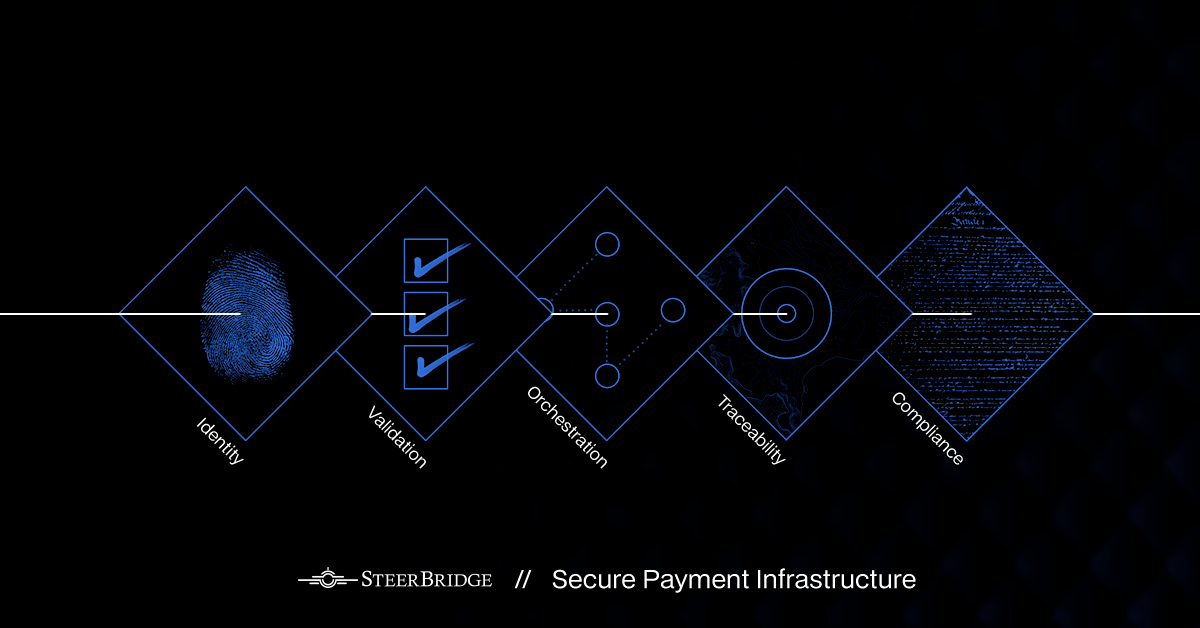
Effective secure payment infrastructure relies on several architectural layers working together to ensure financial integrity.

 1. Identity Verification  

The first layer of payment security confirms that the payment recipient is a legitimate entity.

Identity verification mechanisms validate recipient credentials before payments are approved. This reduces the risk of fraudulent accounts entering the payment system.

In modern environments, identity verification may include:

→  Credential validation
→  Secure authentication protocols
→  Identity verification services
→  Alignment with cybersecurity frameworks

However, confirming identity alone is not enough.

 2. Account Ownership Validation  

A common source of improper payments occurs when funds are directed to incorrect or fraudulent accounts.

Account ownership validation ensures that the destination account actually belongs to the intended recipient.

This validation layer helps organizations:

→  Prevent misdirected funds
→  Reduce administrative errors
→  Detect fraudulent account changes
→  Confirm legitimate financial endpoints

By verifying both identity and account ownership, organizations create a stronger foundation for payment security.


3. Secure Transaction Orchestration 

Modern payment ecosystems must operate across multiple financial networks, government systems, and regulatory frameworks.

Transaction orchestration provides the infrastructure that governs how payments move through this environment.

This layer manages:

→  Payment routing
→  Modality selection
→  Authorization checks
→  Risk monitoring
→  Transaction control policies

Secure orchestration allows organizations to support multiple payment methods while maintaining centralized oversight.

4. Traceability and Audit Visibility

For government agencies, financial institutions, and regulated organizations supporting public sector payment programs, audit readiness is essential.

Payment systems must maintain full transaction traceability, enabling organizations to track every payment from initiation to settlement.

Secure payment infrastructure captures:

→  Transaction metadata
→  Validation checkpoints
→  Authorization records
→  Routing history
→  Settlement confirmation

These capabilities support internal oversight, simplify audits, and help organizations detect anomalies quickly.

March Infographic 2 (1)


Preventing Improper Payments Through Architecture  

Fraud prevention and improper payment mitigation are often treated as compliance functions.

But in reality, they are architecture challenges.

When payment infrastructure includes validation, monitoring, and orchestration at the system level, organizations can stop risky transactions before funds move.

Architectural safeguards help organizations:

→  Block fraudulent transactions before disbursement
→  Reduce payment processing errors
→  Strengthen regulatory compliance
→  Improve financial accountability

Instead of reacting to fraud after the fact, organizations can prevent it by design.

Building Payment Systems That Scale  

Payment modernization must also account for long term flexibility.

Rigid systems often require costly replacements when new payment technologies emerge. Modern payment infrastructure architecture avoids this problem through modular design.

API driven payment ecosystems allow organizations to integrate new payment capabilities without replacing entire systems.

These architectures can support:

→  ACH payments
→  Real time payment networks
→  Virtual card disbursements
→  Prepaid card programs
→  Digital wallet integrations

Flexibility becomes a function of architecture, not repeated system overhauls.

Questions Leaders Should Ask Before Modernizing Payments  

Organizations considering payment modernization should evaluate the underlying architecture supporting their systems.

Key questions include:

How is recipient identity validated before funds are released?

How is account ownership verified?

What controls prevent improper payments?

How are transactions monitored across payment channels?

Does the system provide full audit traceability?

Can the infrastructure scale across multiple programs or agencies?

These questions shift modernization discussions from payment features to financial system integrity.

Secure Payment Infrastructure Builds Trust

Payments represent more than financial transactions.

They represent trust between institutions and the people they serve.

For government agencies, financial institutions, and regulated organizations supporting government payment environments, that trust depends on systems that deliver security, transparency, and control.

Secure payment infrastructure ensures that every payment:

→  Is sent to the correct recipient
→  Moves through verified channels
→  Can be fully traced and audited

SteerBridge designs secure, compliant, and auditable payment infrastructure that helps government programs strengthen oversight, reduce improper payments, and protect public funds.

Because payment modernization is not about moving money faster.

It is about moving money with control.
About SteerBridge

At SteerBridge, our vision is to be the trusted partner in delivering transformative solutions that empower our clients to navigate complex challenges and seize opportunities for growth. Rooted in our core values of integrity, innovation, and engaged leadership, we strive to elevate the standards of service within the government contracting community.


Mike Kropiewnicki
Mike Kropiewnicki
Mar 19, 2026 9:00:02 AM