SteerBridge Named 2026 Moxie Award Finalist
Federal agencies are under pressure to move faster.
Faster reviews. Faster claims. Faster eligibility decisions. Faster scheduling. Faster safety assessments. Faster answers for the people, teams, and programs waiting on the system to work.
But speed by itself is not the goal.
In high-stakes federal environments, a faster decision only helps if the decision still holds up. It has to be based on the right information. It has to be traceable. It has to be explainable. It has to meet the requirements of the mission. And it has to be trusted by the people affected by it.
That is where modernization gets difficult.
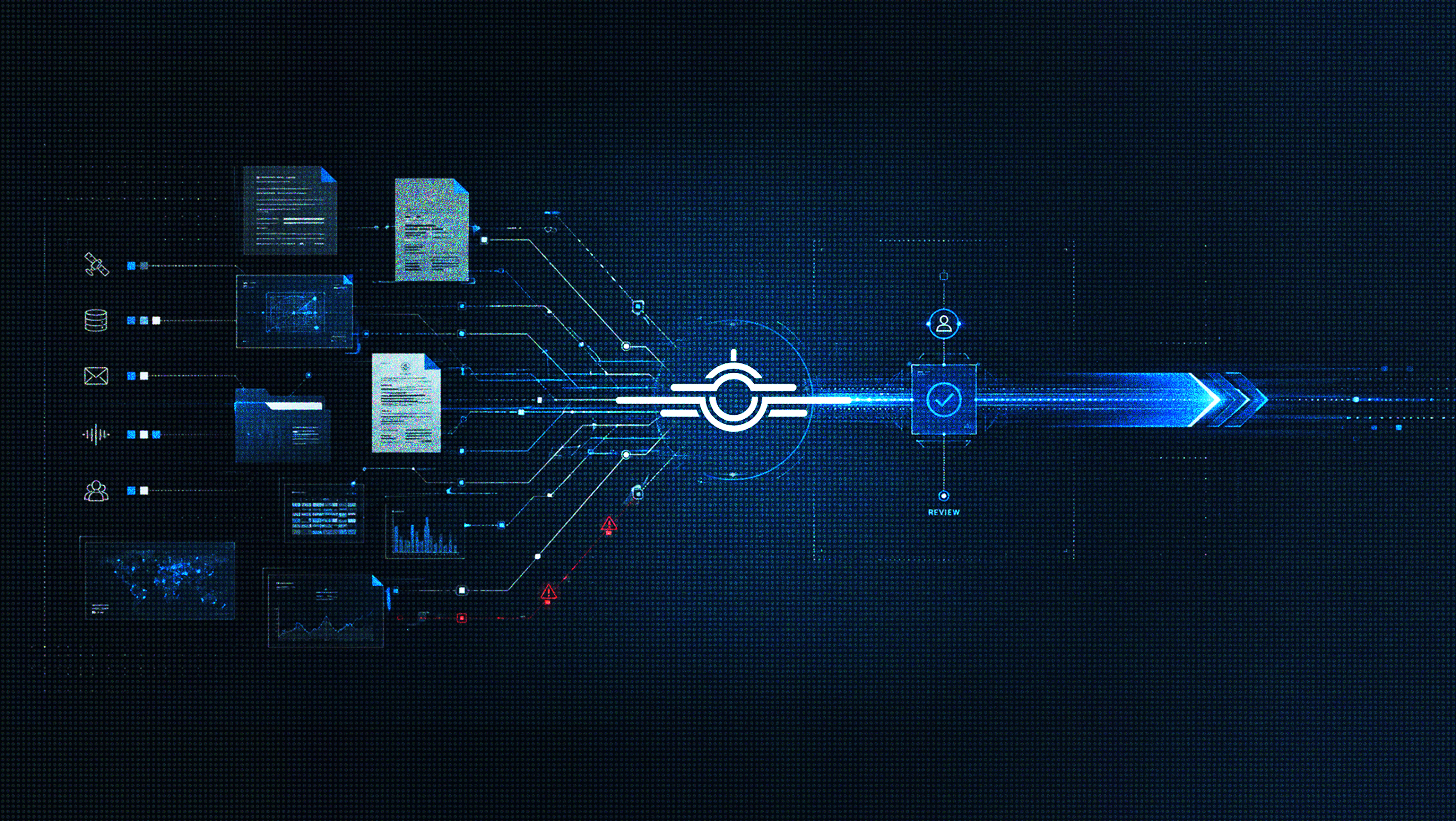
Most agencies are not short on data. They are surrounded by it. Case files, operational records, inspection notes, medical documents, maintenance histories, schedules, policy rules, risk indicators, reports, dashboards, and legacy system exports all contain pieces of the picture.
The problem is that those pieces are often scattered.
The information exists, but it is not always ready when someone needs to make a decision.
A reviewer needs to know whether the right evidence is present.
An analyst needs to understand which records matter.
A safety official needs to see risk before it becomes consequence.
A scheduler needs to balance workload, priority, and availability.
A program leader needs to know where the work is stuck and what can move next.
That is the real modernization challenge: turning fragmented information into decision-ready data.
Data Is Not the Same as Decision Support
More data does not automatically lead to better decisions.
A dashboard can show activity without showing what matters. A workflow tool can move a case forward without reducing confusion. An AI model can surface information, but without context, controls, and human review, it can create more noise than clarity.
Decision support has to do more than collect information.
It has to help people understand what they are looking at, where it came from, why it matters, and what action it supports.
At SteerBridge, we think of decision-ready data as the right information, in the right shape, at the right time, with enough context and traceability for a responsible human to act.
That last part matters.
Federal decisions often affect people, benefits, safety, readiness, resources, operations, and public trust. They need to move faster, but they also need to remain accurate, consistent, compliant, and accountable.
Technology can reduce the burden.
Human expertise still drives the outcome.
AI can accelerate decisions. But in mission environments, speed only matters when the data is trusted.
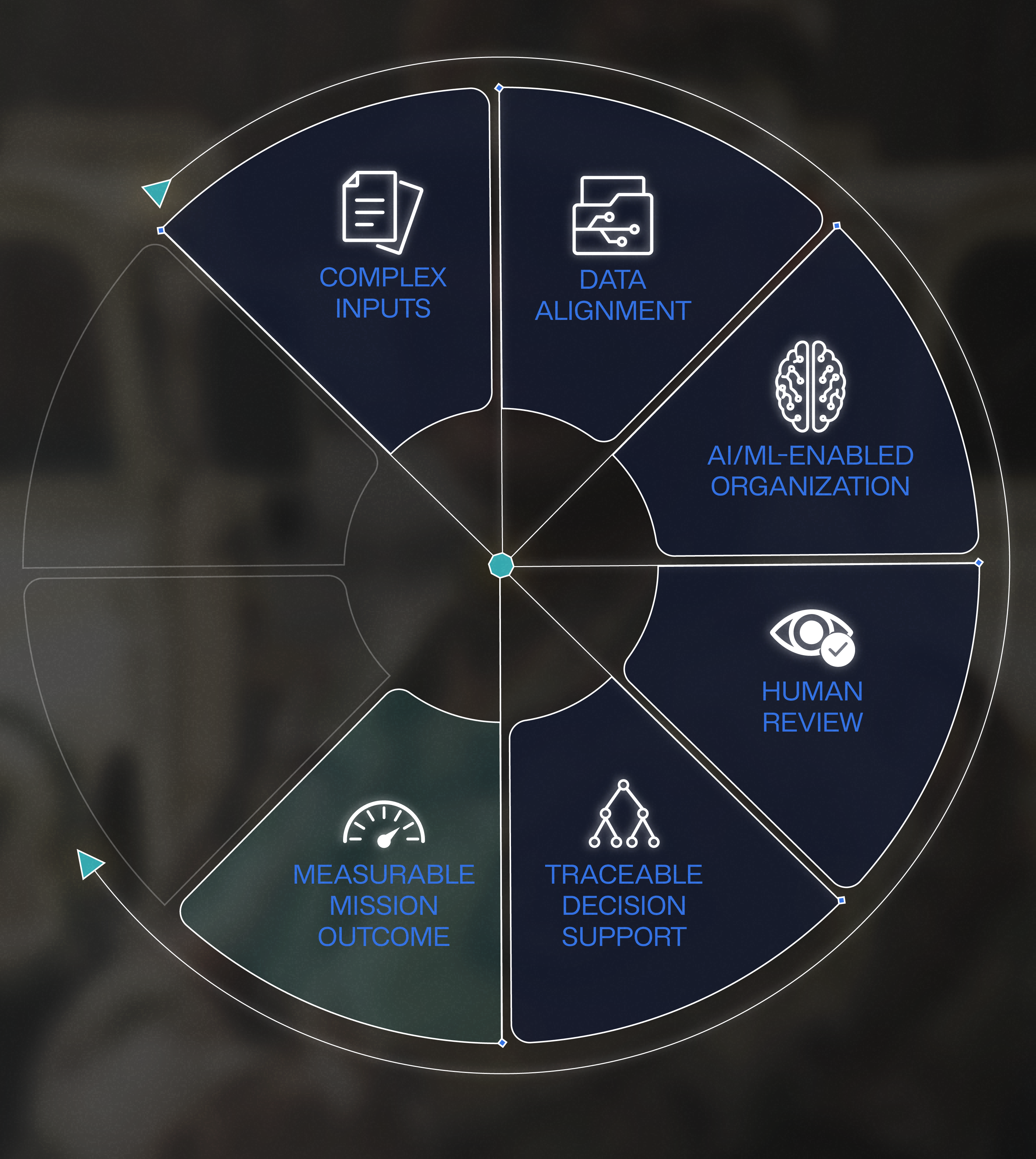
At SteerBridge, we help federal partners move from complex inputs to decision-ready data through secure, traceable, human-informed AI/ML solutions.
That means aligning fragmented data, supporting human reviewers, enabling AI/ML-ready organizations, and delivering measurable mission outcomes.
Because trusted outcomes do not come from automation alone. They come from the right balance of data discipline, human oversight, and mission understanding.
The Decision Point Is Where Modernization Gets Real
Modernization often looks clean in a strategy document.
The real test comes when the work reaches the person responsible for the decision.
That person may be reviewing a benefits file, evaluating eligibility, checking whether documentation is complete, assessing risk, approving a schedule, reviewing operational readiness, or deciding whether a workflow is ready to move forward.
At that moment, the question is not whether the agency has modern tools.
The question is whether those tools help.
Do they bring the relevant information together?
Do they show where the information came from?
Do they reduce repetitive manual review?
Do they surface gaps earlier?
Do they help teams apply rules more consistently?
Do they support required documentation?
Do they keep the human decision-maker in control?
When the answer is yes, technology becomes useful in a practical way. It gives people more clarity, more confidence, and more time to focus on judgment.
When the answer is no, technology becomes another layer teams have to work around.
The goal should not be automation for its own sake.
The goal should be better support where the decision actually happens.
They need clearer workflows, aligned data, and trusted decision support.
Across government, complexity slows progress when systems don’t connect, processes create friction, or decision-makers lack the right information at the right moment.
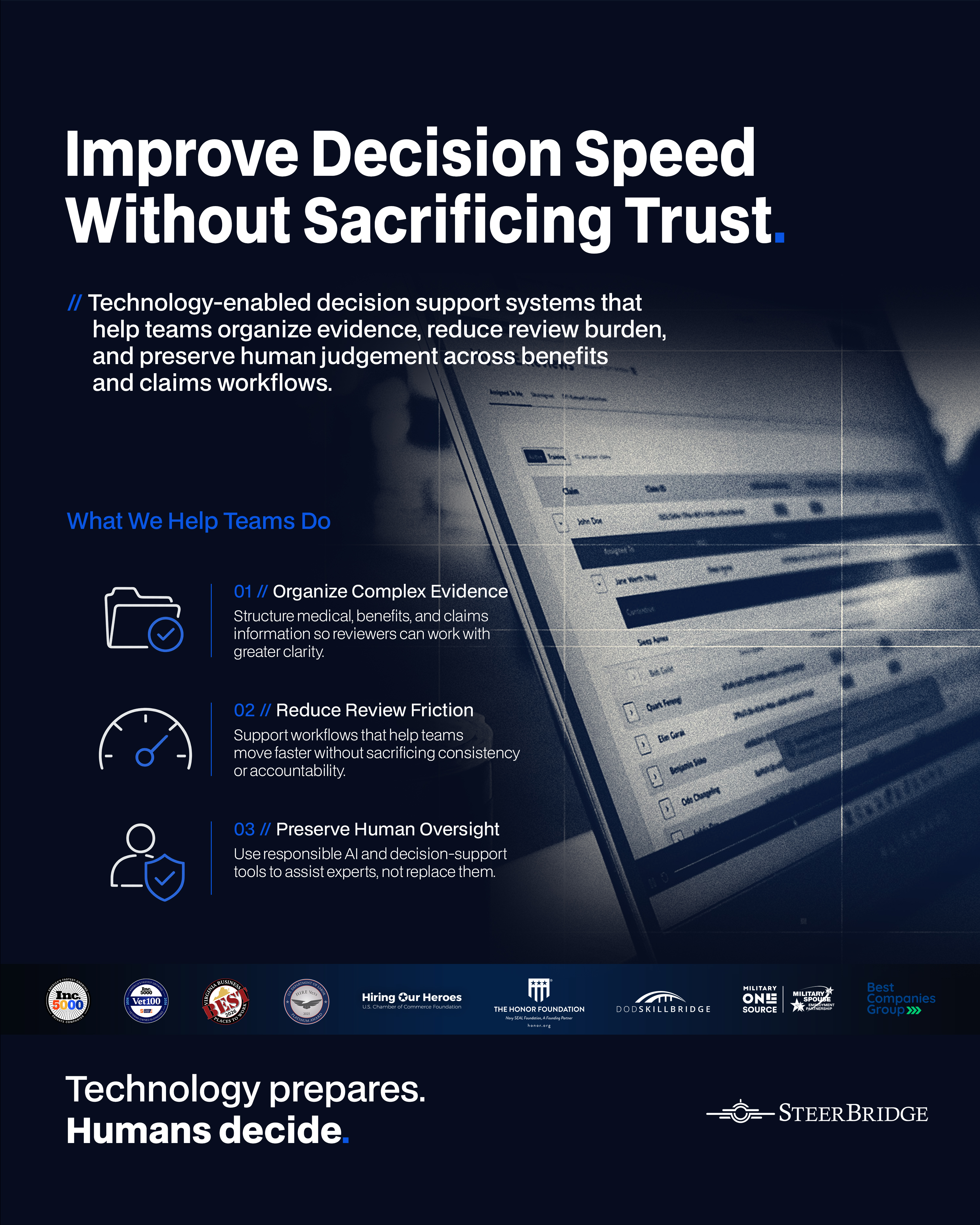
By combining mission expertise, data alignment, automation, and human oversight, we support workflows that move faster without sacrificing trust, accountability, or control.
Because modernization is not just about adding technology.
It is about making the mission easier to execute.
Complexity Usually Starts With the Source Material
In high-volume federal workflows, complexity often begins before anyone reaches the decision itself.
Evidence, records, operational data, case files, schedules, inspection notes, system outputs, and supporting documentation rarely arrive in one clean format. Some information is structured. Some is unstructured. Some is scanned. Some is handwritten. Some lives in PDFs. Some sits inside systems that were not designed to talk to each other.
The information may already exist.
The challenge is preparing it for evaluation.
That is where decision support can reduce friction. It can help reviewers, analysts, planners, and mission owners find what matters, identify gaps earlier, complete required review artifacts, and move work forward while keeping human judgment in control.
This is the difference between simply digitizing a process and actually improving it.
Digitization moves information into a system.
Decision support helps people use that information with greater speed, consistency, and confidence.
Federal agencies make decisions every day that affect real people, critical programs, and public trust.
But the work behind those decisions isn’t always simple. Data lives in different places. Reviews still depend on manual steps. Legacy systems slow teams down. And when handoffs aren’t clear, even the right information can arrive too late.
At SteerBridge, we help agencies improve those workflows so decision-makers have what they need, when they need it.
That means making data decision-ready, reducing unnecessary friction, supporting human reviewers, and helping teams deliver outcomes they can measure and trust.

What We Have Learned From Complex Federal Workflows
SteerBridge’s work across benefits modernization, claims and appeals support, and aviation readiness has reinforced a simple lesson: different missions often share a familiar workflow problem.
The details change. The users change. The stakes change. But the pattern is often the same.
Information is fragmented.
Manual review creates delays.
Teams spend too much time rebuilding the same picture.
Rules and requirements are complex.
Human experts remain accountable for the outcome.
Trust depends on traceability.
The Digital GI Bill is one example of what is possible when a complex benefits workflow is modernized around the mission and the people using the system. SteerBridge supported modernization work that helped improve the experience and decision timeline for Veterans applying for educational certificates of eligibility, reducing a process that previously took about 30 days down to minutes.
That proof point matters.
But the broader lesson matters more.
Modernization works when it makes the workflow clearer. It works when data becomes usable at the moment of decision. It works when technology supports people instead of trying to route around them.
Supporting Human Review Without Replacing Judgment
In high-volume review environments, the burden often falls on the people responsible for making sense of complex records.
They may be reviewing a benefits file, evaluating eligibility, checking an evidence package, assessing whether documentation is complete, reviewing a safety case, or determining whether a workflow is ready to move forward.
The mission changes, but the burden is familiar: find the right information, understand what is missing, apply the right rules, and document the basis for the next action.
That work becomes harder when evidence, records, notes, schedules, and operational data are buried across systems that were never designed to work together.
This is the kind of challenge SteerBridge’s Artificial Intelligence Claims Evaluation System was built to address.
The platform supports high-volume claims and appeals workflows by helping process complex evidence packets, surface relevant clinical and procedural facts, and pre-populate structured outputs for human review. It does not make final decisions. Every output is reviewed and approved by a qualified human before any action is taken.
That distinction is important.
In high-stakes decision environments, AI should not replace accountable judgment. It should help organize the work around that judgment.
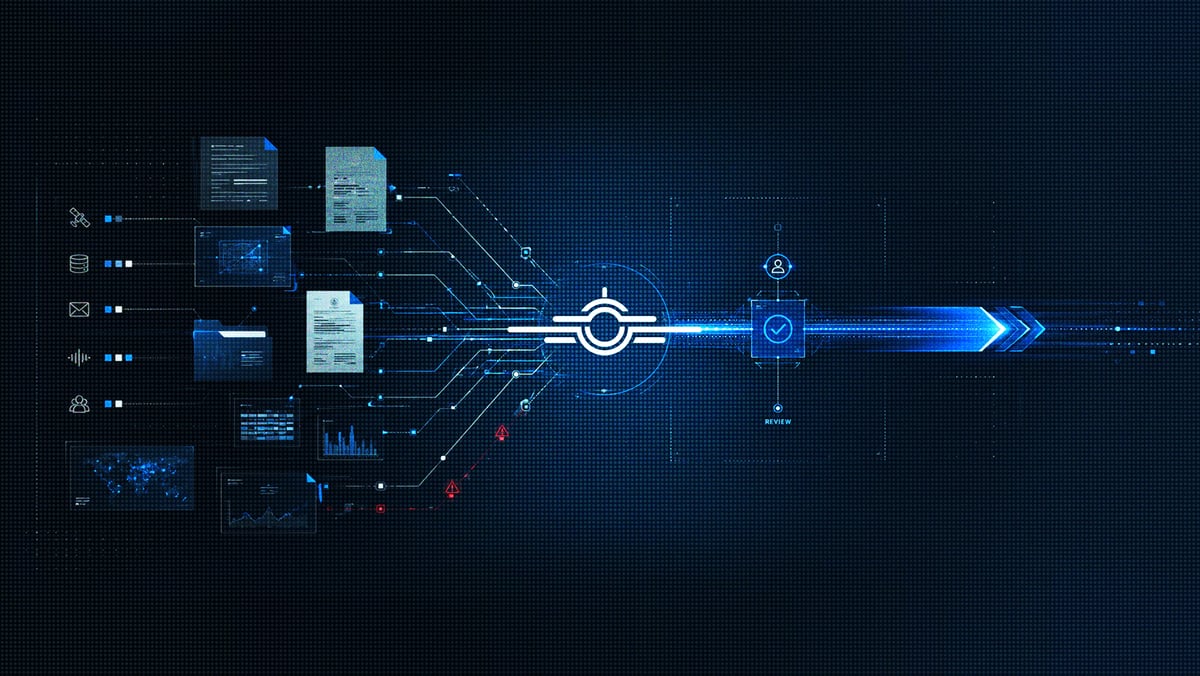
The Artificial Intelligence Claims Evaluation System works through auditable stages: intake, document processing, evidence evaluation, and output generation. It works only with evidence already in the file. It cannot invent, assume, or fill in information that is not present in the record.
That is the kind of guardrail federal programs need.
The value is not just speed. It is clearer information, earlier gap identification, more consistent review support, less avoidable rework, and a transparent trail that shows what the system surfaced and what the human reviewer did with it.
Supporting Operators Before Risk Becomes Consequence
In operational environments, the problem looks different, but the decision-support pattern is similar.
Leaders need to understand readiness, risk, resources, scheduling, maintenance posture, supply constraints, training status, and mission requirements. Those inputs often live in different places and update on different timelines.
Teams can spend valuable time reconciling information before they can even start making decisions.
SteerBridge’s Aviation Readiness Platform was built for that kind of environment.
The platform brings maintenance, supply, training, planning, and risk data into a single decision surface. It helps commanders, maintenance officers, planners, and other responsible leaders see and act on the true state of their force. It augments human judgment. It does not replace it. Recommendations, schedules, and risk assessments are surfaced for the responsible decision-maker, who retains authority over every operational decision.
That model has relevance beyond one mission area.
Any environment that depends on safety, scheduling, inspections, certification, maintenance, resource planning, or operational risk faces the same basic challenge: people need the full picture before they act.
The Aviation Readiness Platform integrates data sources, applies reasoning shaped by how experienced maintainers and planners actually work, and delivers a continuously updated readiness picture with clear, defensible recommendations.
Again, the point is not to remove the expert.
The point is to give the expert a better operating picture sooner.
The Shared Pattern: Align the Data, Support the Human, Measure the Outcome
Across these environments, strong modernization efforts tend to follow a practical pattern.
First, align the data.
That means bringing the right sources together, cleaning and validating what needs to be cleaned, preserving lineage, and shaping information into something people can actually use.
Second, support the human workflow.
Technology has to fit the way the work happens. A reviewer should not have to hunt through multiple systems to understand a case. A planner should not have to rebuild the same readiness picture every morning. A leader should not have to guess which dashboard is right.
Third, measure the outcome.
Modernization should not end with a pilot or a demo. It should improve a real workflow. That might mean reducing cycle time, improving consistency, surfacing missing information earlier, reducing manual burden, improving scheduling, strengthening oversight, or helping teams act before risk grows.
Fourth, scale what works.
Once a workflow improves, the model can be extended. Not copied blindly. Not forced into a different mission. Extended carefully, with the right domain knowledge, controls, and user feedback.
That is where SteerBridge’s approach is different.
The same technical foundation can support different mission environments because it is built around decision-ready data, Expert in the Loop reasoning, human-authoritative workflows, and traceable outputs.
Trust Has to Be Built In From the Start
There is a lot of noise around AI in government modernization.
Some of it is useful. Some of it is hype.
Agencies do not need vague promises about transformation. They need practical systems that can operate inside regulated, high-accountability environments.
That means trust cannot be added later. It has to be designed into the system from the beginning.
For SteerBridge, that trust model includes:
Human authority over decisions
Expert feedback built into the operating loop
Domain-grounded reasoning
Transparent evidence trails
Audit-ready lineage
Secure, federally aligned cloud architecture
Clear visibility into what the system surfaced and why
The Artificial Intelligence Claims Evaluation System links suggested findings back to the underlying document, page, and passage. Every AI suggestion can be logged with the evidence it relied on, the model version used, and the human action taken.
The Aviation Readiness Platform uses the same trust-first approach in operational environments, with Expert in the Loop reasoning, domain-grounded models, and human-authoritative workflows where every schedule, plan, and risk call remains the responsibility of the human owner.
Both systems are built on a Medallion data architecture that separates raw ingest, conformed and validated data, and curated decision-ready datasets. That structure supports governance, lineage, reuse, and the traceability federal programs depend on.
This is what responsible modernization looks like.
Not AI making decisions in the dark.
Not automation without accountability.
Not faster workflows that lose the evidence trail.
Technology prepares. Humans decide.
Moving Faster Without Moving Blind
The agencies that will make the most progress are not the ones chasing the most tools.
They are the ones that can identify the workflow holding the mission back, align the data around it, support the people responsible for the decision, and measure whether the outcome actually improved.
That is how modernization becomes real.
For benefits, claims, eligibility, and review environments, it may mean helping teams find the right evidence faster, identify gaps earlier, reduce avoidable rework, and apply rules with greater consistency.
For safety, certification, maintenance, scheduling, and operational environments, it may mean giving leaders a clearer view of risk, readiness, resources, and timing before problems compound.
For program leaders, it may mean seeing where work is stuck and knowing which intervention will move the mission forward.
The missions are different. The modernization pattern is familiar.
SteerBridge helps agencies move from fragmented data to decision-ready action, with technology that supports human judgment and workflows designed for measurable outcomes.
Because moving faster is not enough.
Agencies need to move faster with clarity, confidence, and trust.
Faster Decisions. Trusted Outcomes.
Faster reviews. Faster claims. Faster eligibility decisions. Faster scheduling. Faster safety assessments. Faster answers for the people and programs depending on the system to work.
But speed alone is not the goal.
In high-stakes federal environments, faster decisions only matter if the outcomes can still be trusted.
That means agencies need more than fragmented data, manual handoffs, and disconnected tools. They need decision-ready data, clearer workflows, and trusted support that helps people act with confidence.
About SteerBridge
At SteerBridge, our vision is to be the trusted partner in delivering transformative solutions that empower our clients to navigate complex challenges and seize opportunities for growth. Rooted in our core values of integrity, innovation, and engaged leadership, we strive to elevate the standards of service within the government contracting community.
Jun 23, 2026 4:30:50 PM