
The Mission on the Other Side of the Workflow
How Joel Gutzmer Is Improving Claims Processing at SteerBridge
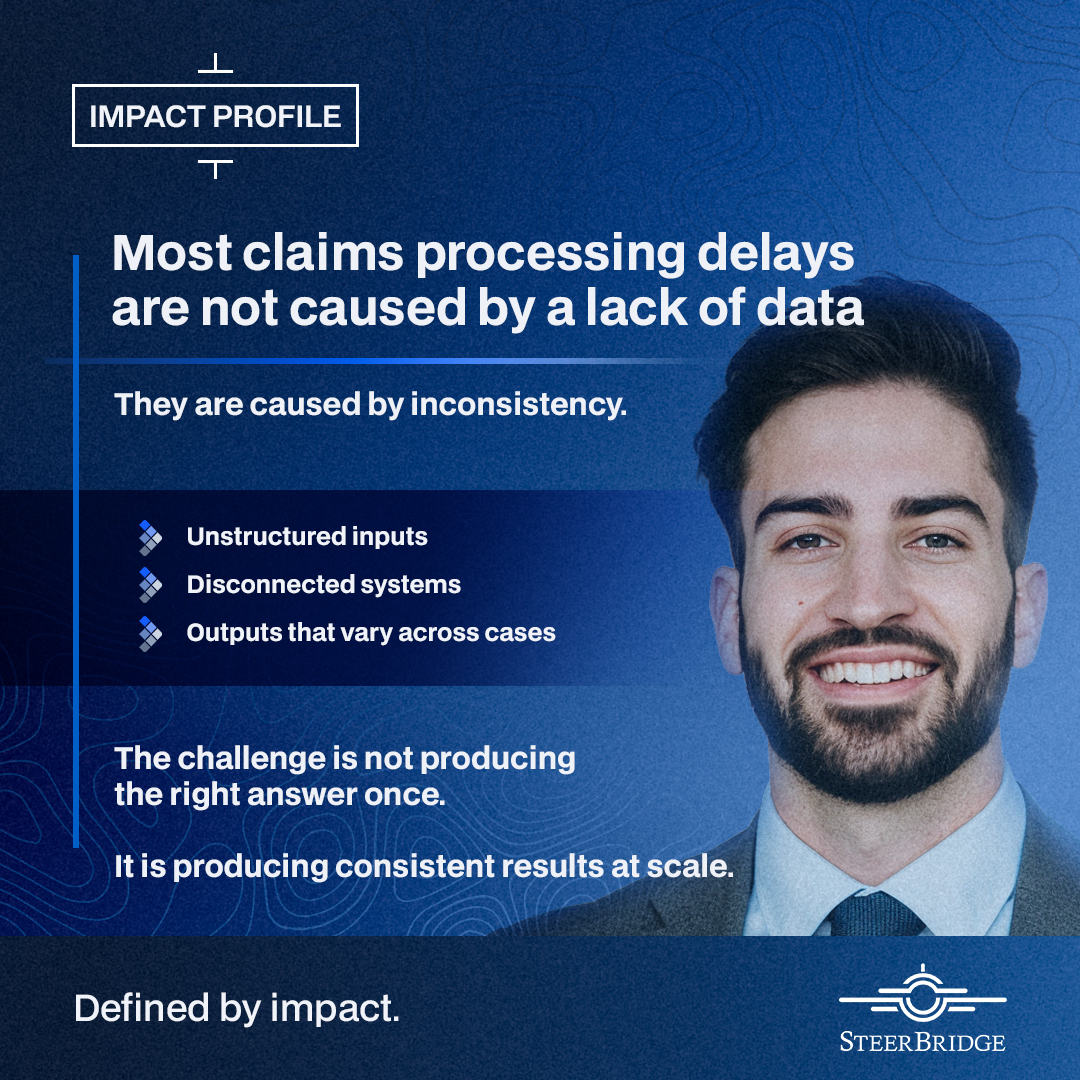
Government systems rarely struggle due to a lack of data.
More often, they struggle with consistency.
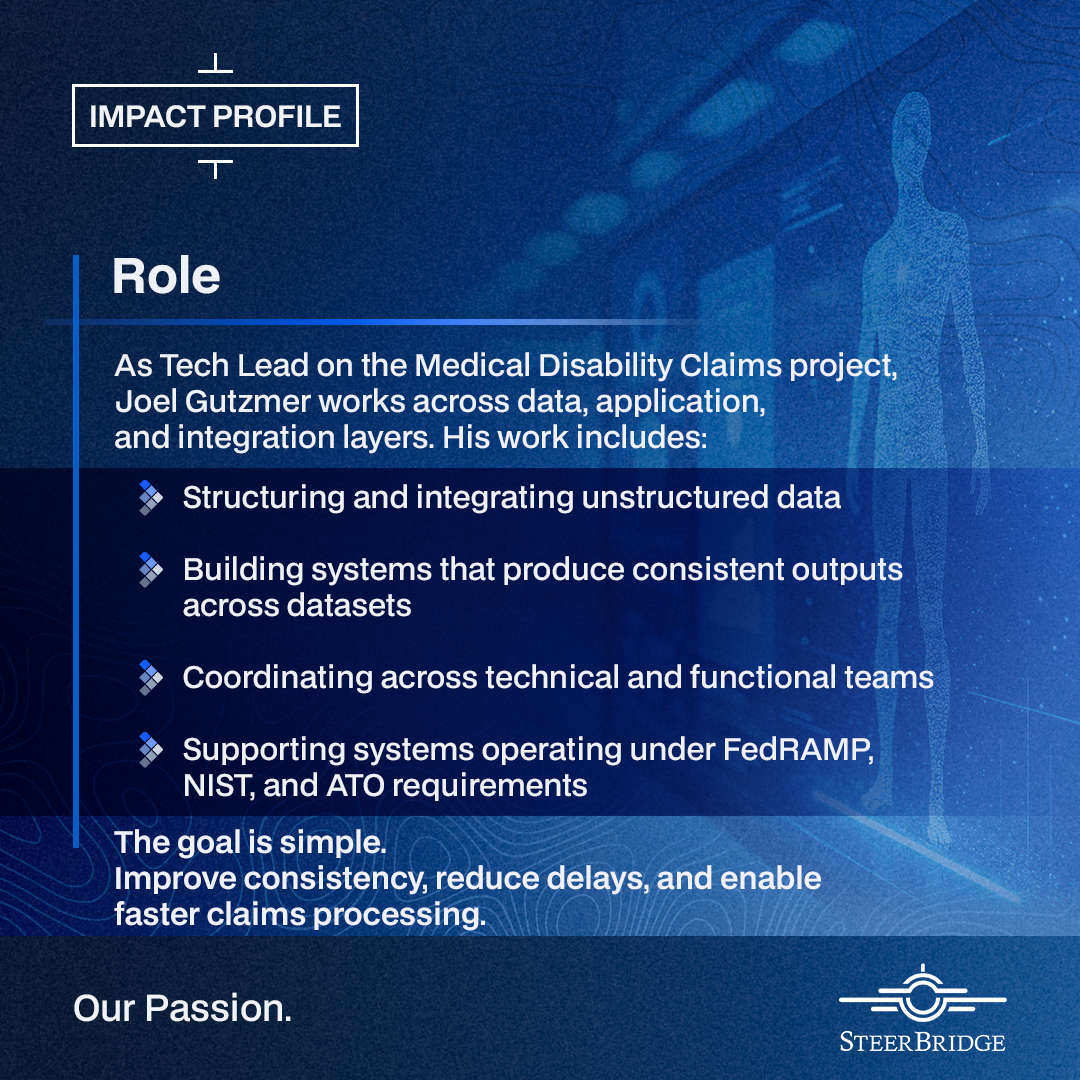
For Joel Gutzmer, Tech Lead on the Medical Disability Claims project at SteerBridge, this challenge is central to his work supporting medical disability claims evaluations in federal environments.
Disability claims processing involves large volumes of structured and unstructured data, multiple systems, and workflows that must operate reliably across thousands of cases.
Producing the correct result once is not the challenge.
Maintaining that level of performance across varied inputs, evolving requirements, and real-world constraints is where complexity emerges.
Engineering Across Systems and Teams
Joel’s background spans data engineering, application development, and system integration, along with experience working with the Department of Defense.
His work operates at the intersection of technology and coordination.
Many of the problems he addresses are not confined to a single system. They span multiple platforms, teams, and functional areas, requiring alignment across both technical and operational stakeholders.

Working Within Real Constraints
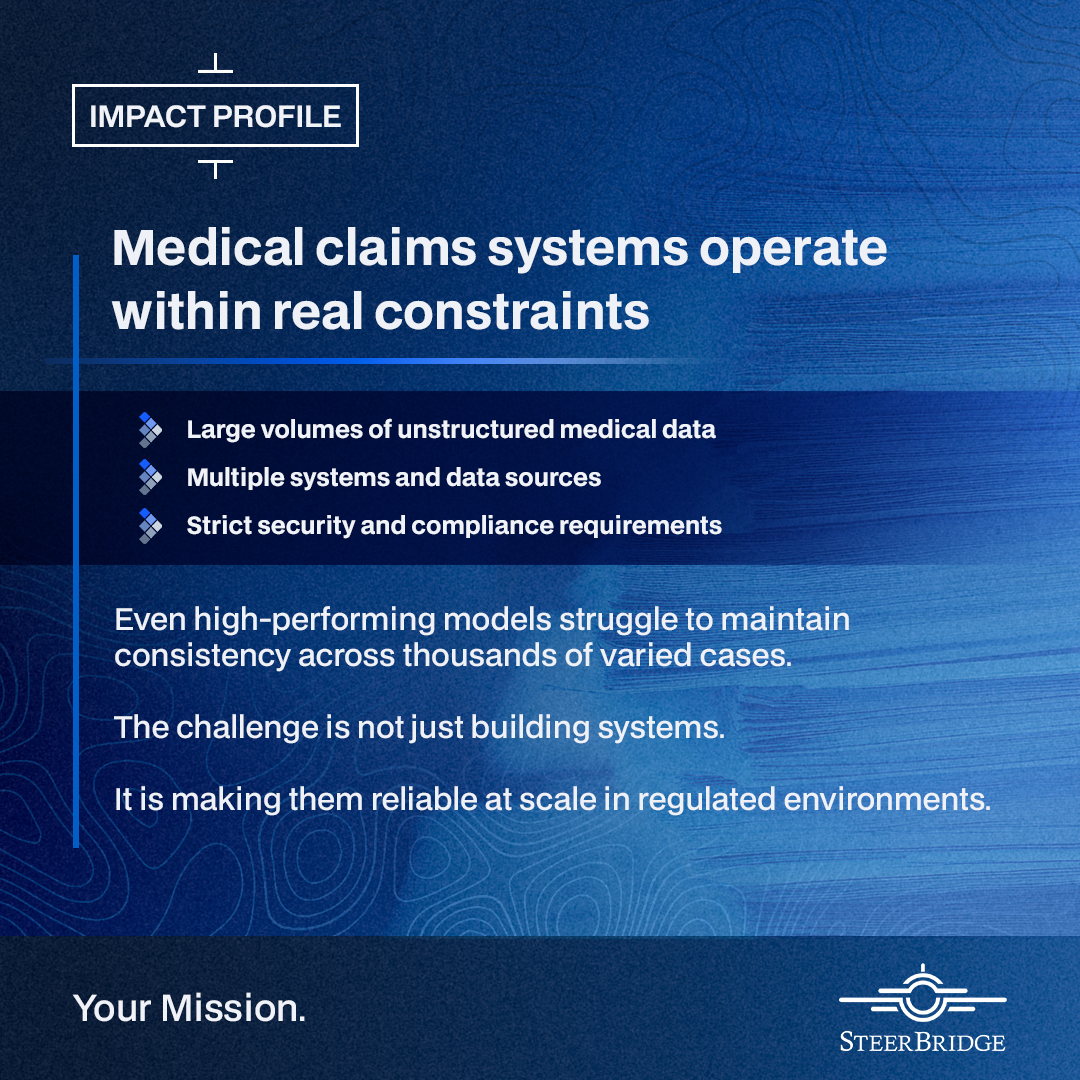
Medical claims systems operate within strict regulatory and security frameworks, including FedRAMP, NIST, and Authority to Operate requirements.
One of the earliest challenges on the Medical Disability Claims project was navigating the ATO process.
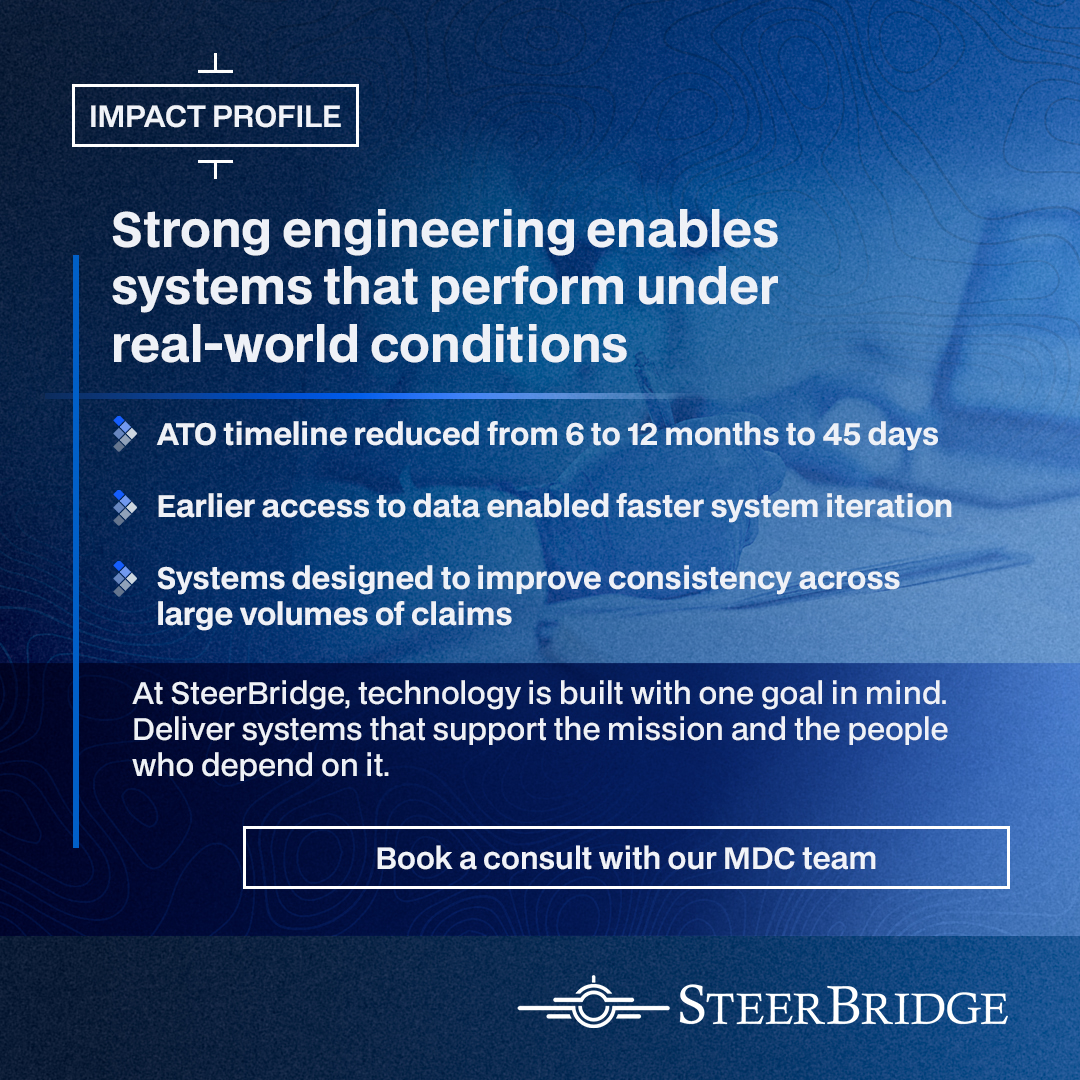
Systems that handle sensitive medical data typically require 6 to 12 months to achieve authorization.
Through coordinated engineering, security alignment, and sustained effort across teams, Joel and the broader team achieved authorization in 45 days.
This accelerated timeline allowed earlier access to production data and enabled faster iteration on system development.
Making AI and Data Systems Work at Scale
A key focus of Joel’s current work is improving consistency across unstructured data.
While generating a correct output once can be straightforward, maintaining that performance across thousands of varied datasets requires continuous refinement.
This includes:
→ Establishing reliable decision points across data
→ Designing systems that perform consistently over time
→ Applying guardrails and human validation at critical stages
Responsible use of AI in this environment requires clear boundaries, thorough testing, and validation at key decision points.
Progress Over Perfection
One of Joel’s guiding principles is that solutions do not need to be complete to be valuable.
In many cases, delivering an 80 percent solution that provides immediate value and can be iterated on is more effective than waiting for a fully complete system.
This approach allows teams to move faster, learn from real-world use, and improve systems over time.
Supporting the Mission
The goal of this work is straightforward.
Enable organizations to process medical disability claims faster and more accurately.
By improving how data is structured, integrated, and used, Joel and the team help reduce delays and improve consistency across the system.
Interested in learning how SteerBridge supports secure, scalable systems for federal programs?
Connect with the SteerBridge team to learn more about how we build secure, scalable systems for federal programs.



.jpg?width=500&height=500&name=Blog%20Image%20(1).jpg)