

From Investment to Readiness: The Execution Layer of VA Modernization
Three Mission Platforms, Three Different Challenges: How SteerBridge Builds Technology Around the Mission
Modern missions do not all fail the same way.
In aviation readiness, the challenge may be fragmented signals across maintenance, supply, training, planning, and operational risk.
In benefits decision-making, the challenge may be evidence that is difficult to organize, review consistently, trace clearly, or act on with confidence.
In secure payments and benefit access, the challenge may be a user who needs better visibility, stronger controls, mobile support, and confidence in the experience around the benefits they depend on.
These are not the same mission environments. They do not have the same users, workflows, risks, or technical requirements.
That is why SteerBridge does not build one-size-fits-all technology.
We build mission-specific platforms around the environment they serve, with a consistent standard across each one: mission fluency, secure architecture, user-centered design, operational discipline, traceability, and accountable execution.
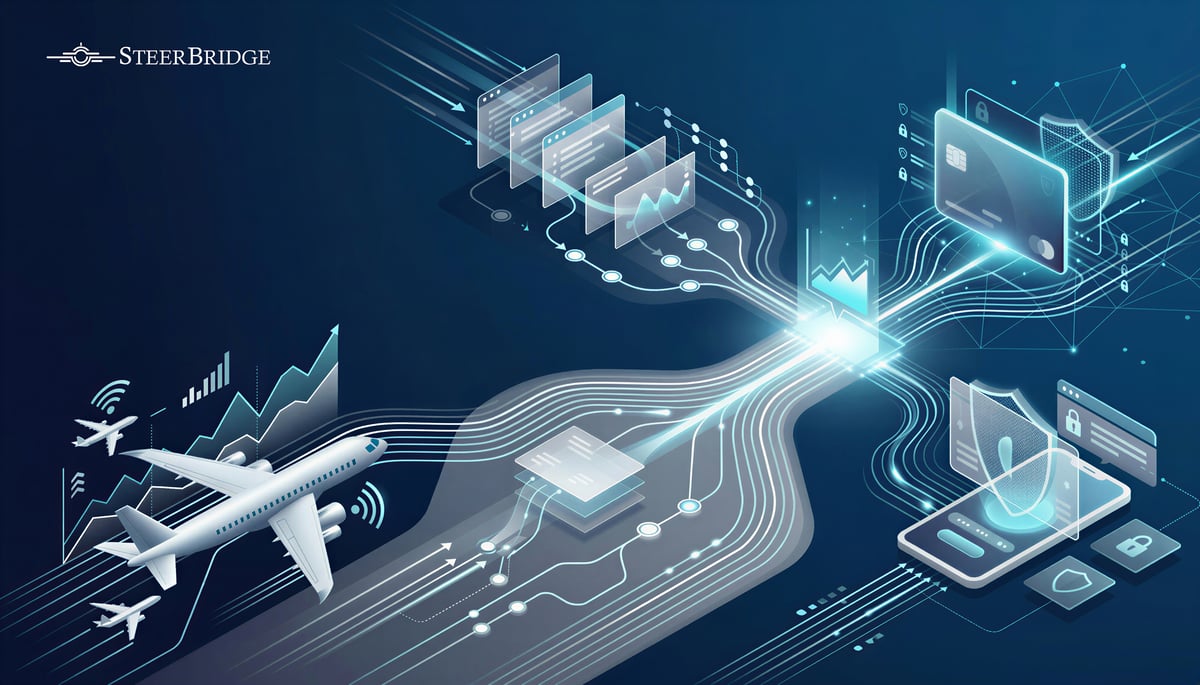
This approach is reflected across three SteerBridge platform examples: Aviation Readiness Platforms, the Benefits & Decision-Making Platform, and the SteerFi Payments Platform. Each platform addresses a different mission challenge. Each requires a different technical approach. And each reflects the same belief:
Technology should help people act with clarity when the mission depends on it.
Before a team talks about dashboards, automation, artificial intelligence, or data visualization, it has to answer a more important question:
What decision are we helping someone make?
That question sits at the center of how Devin Dupaix, Chief Technology Officer at SteerBridge, thinks about responsible platform design.
For Devin, mission technology should not push experts out of the decision. It should help them see earlier, understand faster, and act with greater confidence.
In military planning, decision points are moments where timing, context, and conditions come together clearly enough for a leader to act. A sensor helps leaders recognize when conditions have changed enough to require action.
SteerBridge applies a similar principle to data and platform design.
Find the decision points in the process.
Understand what the expert needs to know.
Place the right signals in the data.
Bring the context forward early enough to matter.
That is very different from building another dashboard.
A dashboard can show information. A decision surface has to do more. It has to connect data to the decision being made. It has to help the person responsible for the outcome understand what they are seeing, where the information came from, and whether it supports action.
This distinction matters because complex mission environments are rarely short on information. More often, the problem is that information is fragmented, delayed, incomplete, disconnected from the workflow, or difficult to trust.
A mission platform should not simply display more data.
It should improve the decision environment around the people who remain accountable.
Aviation Readiness: From Fragmented Signals to Clearer Insight
In aviation environments, readiness is shaped by many moving parts.
Maintenance activity, supply availability, flight-hour data, training inputs, usage patterns, operational planning, and risk indicators often live across different systems, schedules, and workflows. When those signals remain fragmented, teams may spend valuable time reconstructing the readiness picture before they can act on it.
SteerBridge’s Aviation Readiness Platforms are built around that challenge.
The goal is not to replace aviation leaders, maintainers, supply personnel, planners, or analysts. The goal is to help them work from clearer, more usable information.
That starts with the data foundation.
As Principal Data Architect, Aviation, Dr. Magdalyn Elkin helps design the architecture behind SteerBridge’s aviation readiness work. She designs, implements, and maintains backend data warehouses, pipelines, and algorithms that support aviation projects. Her work connects business needs, technical architecture, customer priorities, and analytical outputs so cross-functional teams can deliver trusted insight at scale.
That work happens behind the scenes, but its impact is central to mission technology.
Before analytics can support planning, before algorithms can help surface patterns, and before leaders can work from readiness insight, the data has to be collected, structured, validated, connected, and made useful for the people who rely on it.
A data warehouse is not just a warehouse when it helps clarify a readiness question.
A pipeline is not just a pipeline when it moves the right information into the right shape at the right time.
An algorithm is not just an algorithm when it helps teams identify resource-use patterns, planning opportunities, or areas that require further review.
Magdalyn’s spotlight captures the importance of this foundation. Her architecture work helps turn fragmented aviation inputs into decision-ready insight by giving teams a trusted structure they can build from. It also helps cross-functional teams work from the same foundation, reducing friction between technical teams, analysts, customer-facing teams, and mission stakeholders.
In one example from her work, datasets she designed and engineered helped surface important customer information, including data points that were previously difficult to see. In a complex aviation environment, that kind of visibility matters. When information is hidden, disconnected, or hard to interpret, teams lose time and clarity. When the data is structured well, teams gain a stronger basis for planning, review, and action.
That is the aviation readiness challenge in practical terms.
The mission does not need more disconnected displays. It needs trusted architecture, usable data, and decision surfaces that help teams understand what is changing early enough to matter.
Benefits Decision-Making: Supporting Human Review With Traceable Workflows
Benefits decision-making presents a different mission challenge.
Here, the issue is not fleet availability or operational readiness. The issue is how to support human reviewers working through complex evidence, policy requirements, workflow steps, consistency expectations, and accountability standards.
Behind every claim, appeal, or eligibility review is a person waiting for clarity. Behind every decision is a reviewer responsible for evaluating information in a way that is consistent, explainable, and trustworthy.
In that environment, speed matters. But speed cannot come at the expense of trust.
SteerBridge’s Benefits & Decision-Making Platform is designed around human review, evidence organization, workflow consistency, traceability, and auditability. The platform is not meant to replace expert judgment. It is meant to support the people responsible for making or reviewing decisions.
That distinction matters.
In complex benefits environments, the available information may be incomplete, inconsistent, or difficult to interpret quickly. Reviewers may need to understand where evidence came from, how it relates to the case, what policy or workflow steps apply, and whether the decision path can be reviewed later.
A strong decision-support platform helps reduce friction in that process.
It can organize information.
It can support consistent workflows.
It can bring relevant context forward.
It can preserve traceability.
It can strengthen reviewability.
It can help experts spend less time reconstructing the picture and more time applying judgment.
That is where Devin’s principle becomes essential:
Technology prepares. Humans decide.
In benefits modernization, that line is more than a slogan. It is a design guardrail.
Technology should complement, accelerate, and assist expert decision-making. It should reduce administrative burden and organize complexity. But the person accountable for the outcome remains central to the process.
That is why traceability is not a technical extra.
It is part of the trust architecture.
Reviewers and leaders need to understand where the data came from, how it was handled, what logic shaped the output, and whether the final result can be reviewed. If a platform cannot support that level of confidence, it may create more risk than value.
The strongest benefits technology does not simply move cases faster. It helps preserve trust while supporting better workflow discipline, clearer evidence review, and accountable human decision-making.
SteerFi Payments Platform: Secure Access, Visibility, and User Confidence
Secure payments and benefit access require a third platform approach.
Here, the mission challenge is not readiness visibility or evidence review. It is protected access and user confidence.
For GI Bill recipients and other benefit users, payment technology is not an abstract backend function. It shapes the experience of accessing, monitoring, and managing benefits that affect education planning, family planning, budgeting, and daily confidence.
Users need to understand what they have access to. They need to see activity. They need controls that help them manage their card. They need mobile support. They need a secure, user-centered experience that gives them confidence at the point where benefits become usable.
That is the purpose behind the SteerFi Payments Platform.
SteerFi supports secure benefit access through card controls, transaction visibility, mobile support, and user-centered design. It is built around the idea that secure payment technology should protect workflows while also making the experience clearer and more usable for the people relying on it.
This is a different type of mission platform.
The technical requirements are different.
The user journey is different.
The trust signals are different.
The risk profile is different.
But the standard remains the same.
Secure architecture.
User-centered design.
Operational discipline.
Traceability where it matters.
Accountable execution.
For payments and benefit access, trust is built through the user experience as much as the backend. If users cannot see activity, manage controls, or get support, confidence breaks down. If the system is not secure and reliable, trust breaks down. If the experience is generic and disconnected from the benefit environment, the platform misses the mission.
SteerFi is designed around that reality.
Secure payments are not just about moving money. They are about supporting confidence, protection, visibility, and control in moments that matter to the user.
Different Platforms, Same Standard
Aviation readiness, benefits decision-making, and secure payments do not solve the same problem.
The common thread is not identical architecture.
The common thread is disciplined execution.
At SteerBridge, that means building around the mission environment first. It means understanding the user, the workflow, the risk, the timing, and the decision point before defining the platform approach.
It also means pairing subject-matter experts with technologists so the solution starts closer to the mission.
Devin describes this as building a strong mission-informed foundation before asking the customer to refine it. The customer is not forced to start from a blank page. Instead, SteerBridge brings proven design patterns, technical expertise, mission fluency, and working assumptions that can be configured around the customer’s environment.
That approach avoids two common failure modes.
The first is rigid off-the-shelf delivery, where the mission has to adapt to the tool.
The second is fully custom development from zero, where the customer spends too much time defining what a mission-fluent partner should already understand.
Mission-specific platform development requires both structure and flexibility. The architecture has to reflect the environment. The workflows have to support real users. The data has to be trustworthy enough to act on. The outputs have to be understandable enough to review. And the platform has to support the people who remain accountable.
That is why decision surfaces matter.
A decision surface is not just a better dashboard. It is a design philosophy.
It asks whether the platform connects the right data, context, and traceability to the moment an accountable person has to act.
For aviation readiness, that may mean earlier visibility across maintenance, supply, training, planning, and risk.
For benefits decision-making, that may mean organized evidence, consistent workflows, traceable outputs, and human accountability.
For secure payments, that may mean card controls, transaction visibility, mobile support, and user confidence.
Different missions.
Different platforms.
One standard: trusted execution.
What Leaders Should Demand From Mission Technology
Federal, defense, aviation, benefits, and fintech leaders should expect more from mission technology than polished visuals or broad promises.
They should ask:
What decision is this platform helping someone make?
Who is accountable for that decision?
What information does that person need?
When do they need it?
Where does the source data come from?
Can the logic be traced?
Can the workflow be reviewed?
Does the platform reduce friction or create more of it?
Does it support human judgment?
Does it improve confidence in the outcome?
Those questions matter because technology alone does not create mission value. Mission value comes from technology designed around the people, processes, risks, and decisions that define the environment.
That is the difference between generic automation and responsible decision support.
It is the difference between displaying data and supporting action.
It is the difference between a tool that adds noise and a platform that helps people move with clarity.
Building Around the Mission
The future of mission technology will not be defined by who adopts the newest tool the fastest.
It will be defined by who builds the right technology around the right mission problem.
At SteerBridge, that means designing platforms for the environments they serve. It means keeping experts in the loop. It means tying data to decision points. It means building for traceability, usability, security, and accountable execution from the start.
In aviation readiness, the mission requires clearer visibility from fragmented signals.
In benefits decision-making, the mission requires trusted support for human review.
In secure payments and benefit access, the mission requires protection, control, visibility, and user confidence.
Three platforms.
Three different challenges.
One standard.
Technology prepares. Humans decide.
And mission-ready decisions require technology built around the mission.
Interested in Joining the Team?
Explore open roles supporting mission-driven technology: Join the Team
About STEERBRIDGE
At SteerBridge, our vision is to be the trusted partner in delivering transformative solutions that empower our clients to navigate complex challenges and seize opportunities for growth.
Rooted in our core values of integrity, innovation, and engaged leadership, we strive to elevate the standards of service within the government contracting community.

Mike Kropiewnicki
Sep 8, 2026, 4:49:28 PM
Sep 8, 2026, 4:49:28 PM
.jpg?width=500&height=500&name=Blog%20Image%20(1).jpg)